But there are four disasters that are not going to be covered unless you specifically add them.
You think it’s dreary with day after day of rain? Wait until that rain starts coming in a house without flood insurance. photo credit: Decatur FD Flood via photopin(license)
1) Flood. That’s the one that’s on everyone’s mind right now, for stuff like this and this.
Flood insurance is handled by the National Flood Insurance Program and it’s a separate policy from your regular homeowners insurance.
If you live in a 100-year flood plain, your mortgage holder will require you to buy flood insurance (and they’ll notify you of the requirement before they give you a mortgage).
As side note, a “100-year flood plain” does not mean the area’s going to flood once a century. It’s shorthand for an area that has a 1 percent or greater chance of flooding in any given year. In other words, there’s a 26 percent chance of flooding during a 30-year mortgage.
I’ve seen places on a 50-year flood plain — which means there’s a 2 percent chance of flooding in any year — flood twice in five years.
But even folks who aren’t on a flood plain need insurance: According to the NFIP, 20 percent to 25 percent of all flood claims come from low-risk areas.
2) Sinkholes. What could be worse than the ground opening up to swallow everything you own? Finding out that most home insurance policies exclude “earth movement.”
That’s kind of a big deal for those of us here in Missouri. There’s a reason the Show Me State is also known as the Cave State. See, here’s one. And all the recent rain is making them even more threatening, like this one.
There aren’t many insurance companies that will help you here. I know of two and although Farmers isn’t one, Foremost (one of the companies we work with) is. If you’re worried about a sinkhole, you may be better off with the Missouri FAIR Plan’s standalone policy for sinkholes, similar to what the National Flood Insurance Program’s flood insurance.
Most Missourians have heard of the more recent 1811-1812 flurry of quakes that were in the range of magnitude 7-8 and centered near New Madrid, Missouri. Because few people lived in Missouri in the early 1800s, impact to human life was minimal. The three major earthquakes in late 1811 and early 1812, however, did permanently change the course of the Mississippi River and created the Reelfoot Lake in the northwest corner of Tennessee.
Yeah, the largest earthquake in the country happened over on the east side of the state. Not a whole lot of people in Missouri two hundred years ago, so no biggie.
Any idea of what it would do now?
Out of the four big gaps in your home insurance coverage, earthquake is typically the easiest to fix. You just tell your agent you want to add an earthquake endorsement. It doesn’t add much to your premium — typically somewhere between $35 and $100 a year. However, the deductible is usually between 5 percent and 25 percent of your home’s value.
And in case you’re wondering, the earthquake endorsement only covers earthquakes, not sinkholes.
Yes, I’m totally just looking for a reason the show you a picture of my kids & grandkids. Aren’t they adorable? These are some of the people who will be emotionally devastated by my death. But life insurance will make sure they won’t feel it financially.
4. The death of a breadwinner.
This is the one that should be keeping you awake at night if you don’t have a policy in place to protect your family.
We like to think about our home being our biggest asset, but it’s not. Our biggest asset is our ability to earn money. If you’re not there to earn that money, what happens to the house? What happens to the people inside it?
The turning point for me came when I had to fill out a health insurance application about four years ago.
Nonsmokers got better rates, therefore I became a nonsmoker.
And if I had it there, in a contract, I was going to stick to it.
Somehow the cost per pack didn’t faze me as much as the increased cost of my health insurance.
So I understand the problem. Many smokers — especially young smokers — feel fine and enjoy smoking. They can quit any time they want to. The near-certainty of future health consequences loses out to the immediate gratification of taking a drag. And the ones that don’t feel fine figure it’s too late to quit anyway.
I’m using smoking as shorthand for all nicotine users. It’s killing you, regardless of whether you smoke it, chew it or inhale it in a vapor. Image courtesy of Mister GC at FreeDigitalPhotos.net
I was in the same trap. I’d quit later, I just didn’t feel like it yet. It wasn’t until I was going to get hit with an immediate consequence that I decided to finally and permanently quit.
So just in case you need another reason to quit, I’ve got some numbers to throw at you.
And I want you to weigh those numbers against the price of protecting your family.
The first number is the obvious one. How much are you paying for cigarettes?
Missouri is one of the cheapest states to buy smokes and it’s still $5 a pack.
At half a pack a day, that’s $75 a month.
I can get most folks — even smokers — a pretty good life insurance policy for $75 a month.
If you’re smoking a pack a day, that’s $150 a month. Depending on how old you are, we can get you an amazing policy for $150 a month. The kind that helps pay for things while you’re still alive.
Just for fun, here are some more numbers. This is how much it would cost to start a $250,000 10-year term life insurance policy for a woman throughout her lifetime, assuming she’s in average health. (BTW, I sell life insurance through Farmers, so those are the numbers I’m using here.)
A smoker is paying almost double the rate of the nonsmoker.
Why? Because she’s almost twice as likely to use the life insurance (the technical term here is “dying”).
And as she gets older, the smoking woman is more likely to develop health issues that make it harder to get life insurance.
I had a couple in my office earlier this week tell me that protecting their family was less important than their nicotine fix.
No, they didn’t actually say that. They said they couldn’t afford life insurance, but they were spending about $60 a week on cigarettes.
$60 a week? Did I hear that right?
Both the husband and wife smoke, so that’s a little less than a pack a day for each.
He probably didn’t actually say this. But it’s still a good quote.
And no, I don’t want you to wait until you quit smoking to get life insurance. Remember, the noxious weed makes it almost twice as likely that you’re going to die, so you really do need it now.
I want you to get life insurance and quit smoking. Pay for the life insurance with the money you’d set aside for cigarettes. Once you’ve quit for a year. Really and truly quit, call me again. We can send in a nicotine questionnaire and it will reduce your life insurance premium.
Then you have life insurance and money in your pocket.
And yes, I know it’s not easy to quit smoking. Even four years later, I still have cravings — I used to be a newspaper reporter and editor. A cigarette was my excuse to to go outside and gather my thoughts before I wrote or edited. So, of course, the cravings are worse when I’m writing. (Now, for instance.)
A 71-year-old client called me a couple of days ago to talk about life insurance.
He and his wife are refinancing their house and he wasn’t sure they’d make it to see the end of the 30 years.
He and his wife are the second and third 65+ clients who wanted to talk about life insurance in the past month.
Life insurance is almost always a great idea, but we would have had a lot more options if we’d had these conversations 20 or even 10 years ago.
Let’s take a look at what would happen if you had $250 a month to spend on life insurance — it seems like a lot of money, but let’s see how much coverage you get for that money.
Similar to For the best value, get life insurance when you’re young, I’m just using premium estimates for Farmers life insurance and a non-smoker in average health, but the numbers are going to be similar regardless of where you look. And age isn’t the only consideration, but it is a large factor in answering our question, “how much life insurance can I buy?”
For a 21-year-old, $250 a month buys a crazy amount of insurance. He’d be able to get almost $4.3 million with a 10-year term (blue line). Why? Because most people live past their 31st birthday. (Even it’s a 10-year term, get life insurance when you’re young — your older self will thank you for it.
If he pays $250 for a 20-year term (red line), he’s going to get $2.1 million. With a 30-year term (orange line) he’s going to get almost $1.9 million. Again, most people live past their 51st birthday.
The green line is the line for whole life insurance. It’s dwarfed by the term policies, but $420,000 is still a whole lot of money to leave your family.
It’s not really fair to compare a whole life policy to a term policy in a chart like this — permanent policies have a lot more benefits than this chart shows — but I want to show how options dwindle as people get older.
Our hypothetical wage-earner doesn’t get as much when he’s 40, but he’s still getting a whole lot of bang for his buck. Almost $2.4 million for a 10-year term and $193,000 in whole life.
He can still get a 30-year-term life insurance when he’s 50. But he can’t at age 51 — from an insurance company’s point of view, there’s too much risk that he’s going to die before he turns 81.
The 20-year term is still an option at age 60, but not at 61.
At 70, a 10-year term is still an option, just not for the $250 a month we said we wanted to spend. A $150,000 10-year term on a 70-year-old is just under $400 a month.
That green line is still hanging around, though. Our hypothetical man can still get life insurance up to age 80, but by this time we’ve moved out of the realm of taking care of his family and into having enough money for burial expenses.
At the start of December, I thought I was bopping my way through things pretty well.
My agency has continued to grow — big enough that I had to ask my wife, Martie, to come in and help me in the mornings.
She’s been great at it, but we knew she was going to have to quit when our third son was born.
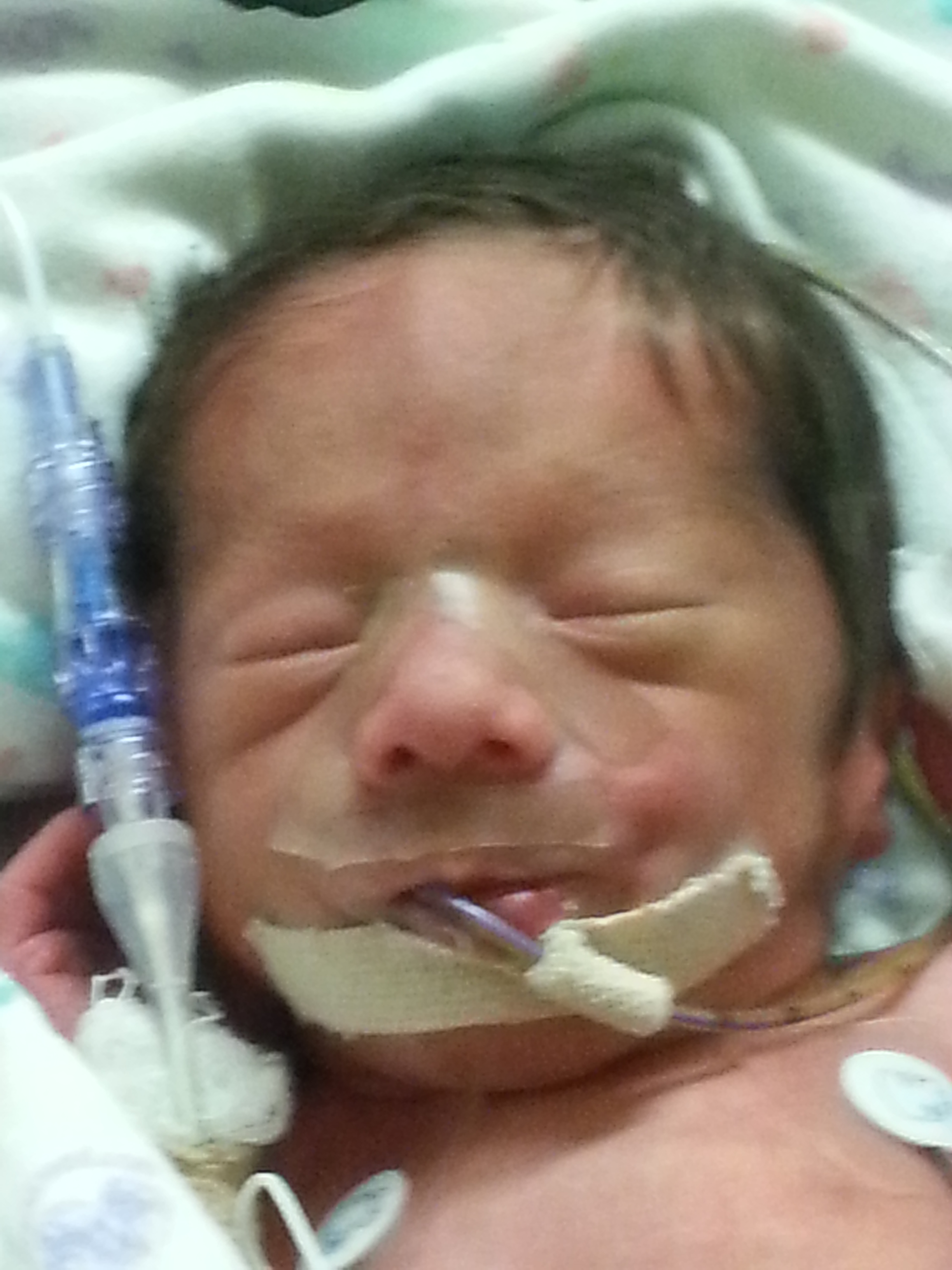
My son, a couple of days after he was born.
I hired Misty to be a telemarketer while Martie was still in the office. Misty was going to work on getting her licenses and move to a full-time role in the office once Martie transitioned back to a full-time mom.
Since our son wasn’t scheduled to arrive until Feb. 5, we thought we had some time to get everything in place.
He had other plans, arriving almost two months early.
So I had several things happening through the month of December:
The woman I relied on to help me in the office suddenly had other things to do — namely spend time with our son in the NICU as well as our other kids.
I suddenly had other things to do — see above.
My telemarketer hadn’t gotten any training or licenses yet, so she wasn’t ready to be the help I needed.
Christmas shopping — because what kind of a maniac has Christmas shopping for their kids done by Dec. 6?
We had a lot of help during that month, but we finally got Gabe out of the hospital less than two weeks ago and now we’re slowly settling back into a routine.
It was a good surprise — an amazing gift — but it has definitely changed our lives.
My job as an insurance agent is to help people prepare for the life-changing events that don’t always have a happy ending.
Home insurance, auto insurance, life insurance, business insurance, they’re all just ways to help insulate you from car accidents, tornadoes, the death of a loved one.
So that you can bounce back when life sneaks up on you and hits you with something that changes everything.
Even thinking about life insurance can be more than a little frightening.
It’s an emotional decision: You’re admitting your own mortality. (Yeah, sorry Sunshine. You’re going to die. I hope it’s after a long and happy life. But the Angel of Death is standing by.)
Everyone knows it. Believing it is a different story.
It’s also a financial decision: Should you spend money on this? You have other bills to pay.
But what would happen to your family if something happened to you? If money’s tight now, imagine what would happen if you died in a car accident on the way to work. Would they be able to stay in your home? Would they have to rely on help from family members to pay the bills?
Full disclosure here: Insurance — including life insurance — wasn’t something I’d thought about before I became an insurance agent. I had what I could get through work and figured my wife would figure it out after that.
What I had through work was about a year’s salary. My family’s kinda counting on me to be around and pay the bills for longer than that.
My wife is an amazing woman. But I was — and still am — the one paying most of the bills. If something had happened to me, she would have had to deal with the loss of a husband, father and wage-earner all in one fell swoop.
And I really should have known better. I was a newspaper reporter and editor in my former life. Bad things happening to other people was a good chunk of my job: We reported on auto accidents, illnesses, fire, crime and a host of misfortunes on a weekly if not daily basis. A lot of these people had done nothing wrong. They were just in the wrong place at the wrong time.
All too often, the stories would end with, “The family is collecting donations to pay for expenses.”
That’s not something I want to leave my family to deal with. How about you?
But let’s look at it another way.
Let’s assume you make $30,000 a year.
You have insurance on your car. Let’s assume that it’s a $20,000 car. That’s nine months worth of salary.
You have insurance on your home. Let’s figure that at $150,000. That’s five years worth of salary.
Life insurance is insurance on your income. Let’s just figure 10 years worth of income, even if you never get a raise, that’s $300,000.
And you don’t have insurance on it?
Talk to someone about life insurance. It’s a big decision, so make sure you know what your options are. I happen to know a guy, but talk to someone.
(First of all, yes, I have telemarketers. Yes, I know it can be annoying, but I’ve been able to help a lot of people with telemarketers. So please be nice if we happen to give you a call, OK?)
In any case, she was coughing, so I asked if she was going to die on me. She said she thought she might.
“Well, at least talk to me about life insurance first,” I told her.
“No, I’m not old enough for life insurance,” she said.
OK, hold up. We were joking around, but now we have to have a conversation. In about two minutes I threw together a proposal and made her come sit in the office.
Plus, there are life insurance options that build up a cash value. That cash value can make the policy pay for itself or even build up enough to pay for other stuff, like a down payment on a home, or to supplement a retirement. The longer the time frame (the younger you are when you buy it), the bigger and quicker the return possibilities. That’s also why I have life insurance on my kids.
And it’s a whole lot easier to get life insurance before the years start falling behind you, the cholesterol starts collecting in your arteries and the fat starts collecting everywhere. (Technical term here is “protecting your insurability,” just in case you’re keeping track of buzzwords.) That’s another reason I have life insurance on my kids.
So, if she ever thinks she may need a chunk of cash at some point in her life, life insurance is a good way of building that up.
If she ever plans to have kids, she’s going to need life insurance. Yes, even for stay-at-home moms. (Do you have any idea how much day care is? That’s why my wife stays at home. It’s also why I have life insurance on her).
It’s kind of like the old joke about trees. The best time to plant a tree is 20 years ago. The second best time is now.
The best time to get life insurance is 20 years ago. The second best time is now.
This has been on my mind a lot in the past day or so: Life insurance for children.
It’s not something that anyone wants to think about, much less talk about, but let me explain why I have policies on my two young sons.
1) In the best of all possible worlds, my sons will live long, happy lives and have kids of their own who rely on them. If that’s the case — and statistically, it probably will be — I’ve already started protecting the grandchildren who are 20 or 30 years in the future.
Plus, these are cash-value accounts, so I’ve started a nest egg for them.
2) It protects their insurability. So we don’t have to worry about whether my boys will be able to get life insurance, even if one finds out he has asthma, or diabetes, or any number of things that could make it harder for a person to get life insurance in the future.
3) This is the one that no one wants to think about, but it’s the one that has everyone in the Ozarks holding their kids a little tighter this week.
If something happens to my boys, I will no longer be a functioning human being.
Even the thought of something — anything — happening to one of those two makes me want to curl up into the fetal position, preferably wrapped around both of them.
Life insurance wouldn’t bring them back.
But it would allow me to pay the bills while my family tries to figure out how to put our lives back together. It would allow me to pay for a funeral. It would allow me put the world on hold with one less thing to worry about.






 The world as I see it